
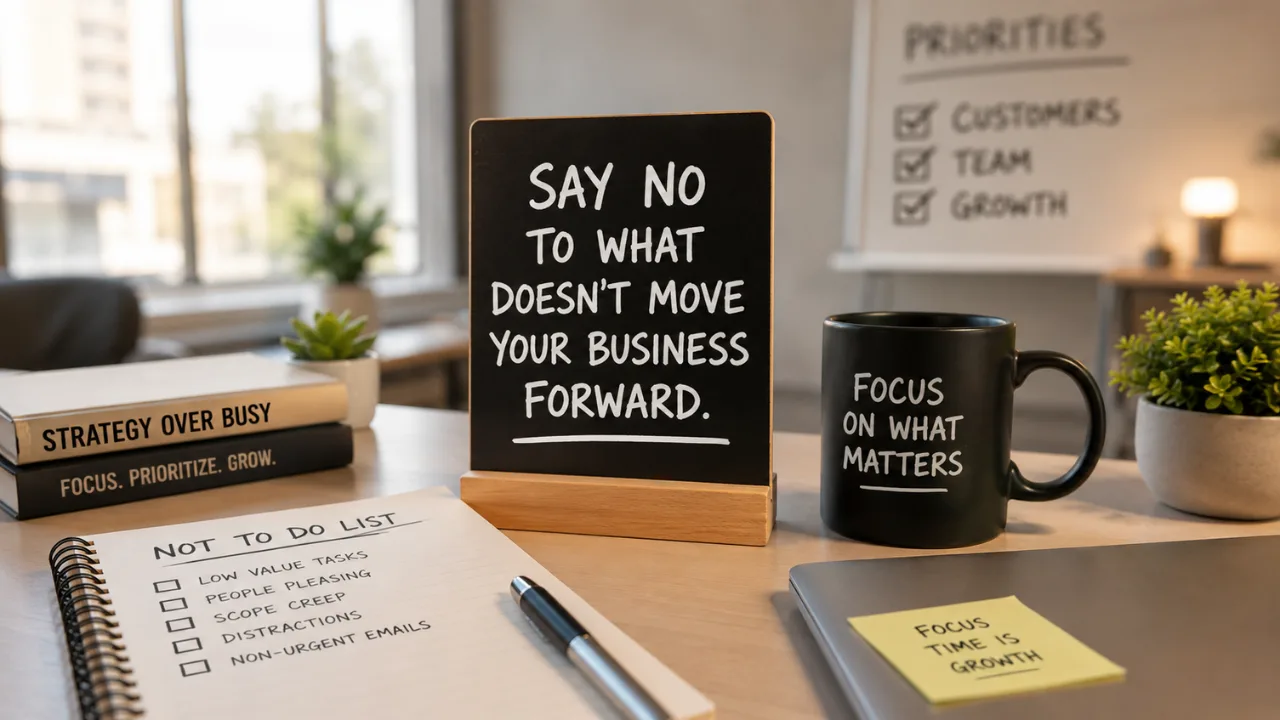
Mark never intended to become “the guy who does everything.”
When he started his home renovation business, saying yes seemed like the obvious path to success. A customer wanted a small project squeezed into an already busy week. Yes. Another asked if he could work evenings to meet a deadline. Yes. Someone requested a service that wasn’t really his specialty. Yes again.
At first, it worked. His reputation grew, referrals increased, and his calendar filled months in advance. From the outside, it looked like business was booming.
Behind the scenes, however, the story was different.
Projects were taking longer than expected because he was constantly switching between jobs. Long hours became the norm. His family saw less of him. His team struggled to keep up with changing priorities, and the quality that had earned him those referrals began to slip.
Mark thought he had a time management problem.
What he actually had was a boundaries problem.
Many entrepreneurs believe growth comes from saying yes to every opportunity. In reality, sustainable growth often comes from knowing which opportunities deserve your time and which ones quietly pull your business off course.
Every “Yes” Comes With a Cost
One of the biggest misconceptions in business is that saying yes is free.
It isn’t.
Every commitment uses time, energy, money, and attention. Those resources are limited, regardless of how ambitious or capable you are. When you agree to something that isn’t aligned with your goals, you’re giving up the opportunity to spend that same time on something that is.
Economists call this opportunity cost. It refers to the value of what you give up when choosing one option over another.
Imagine spending three hours creating a custom proposal for a project with a very low chance of moving forward. Those same three hours could have been spent following up with existing customers, improving your website, training an employee, or working on a strategic partnership that supports long term growth.
The cost isn’t just the three hours. It’s everything those three hours could have accomplished instead.
For small business owners, opportunity cost is one of the easiest expenses to overlook because it never appears on an invoice. Yet it influences almost every decision you make.
Busy Doesn’t Always Mean Productive
Many entrepreneurs wear being busy like a badge of honour.
The calendar is full. The inbox never stops. The phone rings constantly. It feels like progress because there’s always something happening.
The challenge is that activity and productivity are not the same thing.
Research from Microsoft’s 2024 Work Trend Index found that many workers spend a significant portion of their day responding to emails, attending meetings, and managing interruptions rather than completing meaningful work. While the report focuses on workplaces broadly, the lesson is particularly relevant for entrepreneurs who often have even fewer boundaries protecting their time.
If every day is spent reacting to whatever comes next, there is very little room left for planning, innovation, or improving the business itself.
Growing a business requires time to think, not just time to do.
Why Boundaries Make Better Businesses
Some business owners worry that saying no will disappoint customers or cause them to lose opportunities.
In many cases, the opposite is true.
Clear boundaries create consistency. Customers know what to expect. Employees understand priorities. Projects stay on schedule because the business isn’t constantly overcommitting itself.
Boundaries also protect quality.
It’s difficult to deliver exceptional service when every promise is made at the expense of another commitment. Eventually something gives. Deadlines slip. Communication suffers. Stress increases. Customers notice.
Research from the Business Development Bank of Canada (BDC) consistently highlights that businesses with clear plans, defined priorities, and effective management practices are better positioned for long term growth than those operating in constant reaction mode.
Sometimes the best customer experience comes from saying, “We can’t do that this week, but we can do it properly next Tuesday.”
The 80/20 Rule Might Surprise You
One of the most useful business concepts is the Pareto Principle, often called the 80/20 Rule.
It suggests that roughly 80 percent of results often come from 20 percent of the effort, customers, products, or activities. The exact percentages will vary from business to business, but the principle encourages owners to identify what creates the greatest impact.
Think about your own business.
Which customers generate the most revenue?
Which services are the most profitable?
Which marketing efforts consistently bring in new clients?
Which tasks seem urgent but rarely move the business forward?
The answers are often eye opening.
Business owners sometimes discover they’re spending most of their time on work that produces the smallest return. Saying no to low value activities creates more space to focus on the work that truly drives growth.
Try a Time Audit
If you’re unsure where your time is actually going, a simple time audit can be incredibly revealing.
For one week, write down how you spend your working hours.
Be honest.
Include everything from responding to emails and attending meetings to bookkeeping, customer calls, social media, administrative work, and strategic planning.
At the end of the week, ask yourself three questions.
Which activities helped grow the business?
Which activities could be delegated or automated?
Which activities probably didn’t need to happen at all?
Many entrepreneurs are surprised by the results.
Small interruptions that seem harmless throughout the day often consume hours each week.
Build a “Not To Do” List
Business owners love creating to do lists.
Far fewer create a list of things they intentionally won’t do.
A “Not To Do” list might include answering non urgent emails after business hours, accepting projects outside your expertise, discounting prices simply to win work, attending meetings without a clear purpose, or saying yes before you’ve had time to evaluate whether the opportunity fits your goals.
This isn’t about becoming inflexible.
It’s about protecting your capacity to do your best work.
Every successful business has limits. The difference is that thriving businesses define those limits before someone else defines them for them.
Saying No Creates Space to Say Yes
The most successful entrepreneurs don’t say no because they lack ambition.
They say no because they know exactly what they’re building.
Every thoughtful no creates room for a more meaningful yes.
Yes to serving your best customers exceptionally well.
Yes to improving your systems.
Yes to developing your team.
Yes to innovation.
Yes to spending time working on your business instead of constantly being consumed by it.
Over time, those decisions compound into stronger businesses, healthier leaders, and better outcomes for customers.
You Don’t Have to Figure It Out Alone
Setting boundaries can be difficult, especially when your business feels personal.
Every customer matters. Every opportunity feels important. Every decision carries weight.
Sometimes it helps to have someone outside the business ask a simple question.
“Does this move you closer to the business you’re trying to build?”
At Community Futures Lambton, we work with entrepreneurs who are making these kinds of decisions every day. Whether you’re struggling with priorities, growth, staffing, profitability, or simply feeling stretched too thin, our free business coaching provides a chance to step back, evaluate your options, and build a business that supports your goals instead of constantly competing with them.
Growth isn’t about doing everything.
It’s about doing the right things consistently.
Sometimes, the most profitable word in business really is “no.”
References
- Harvard Business Review (2007). “Manage Your Energy, Not Your Time.”
- Harvard Business Review (2023). “Beware a Culture of Busyness.”
- Fast Company (2026). “Busyness is killing strategic thinking. Here’s how to prevent that from happening.”
- Medium (2025). “Work Smarter, Not Harder: Prioritizing Productivity Over Busyness.”